Table Of Content
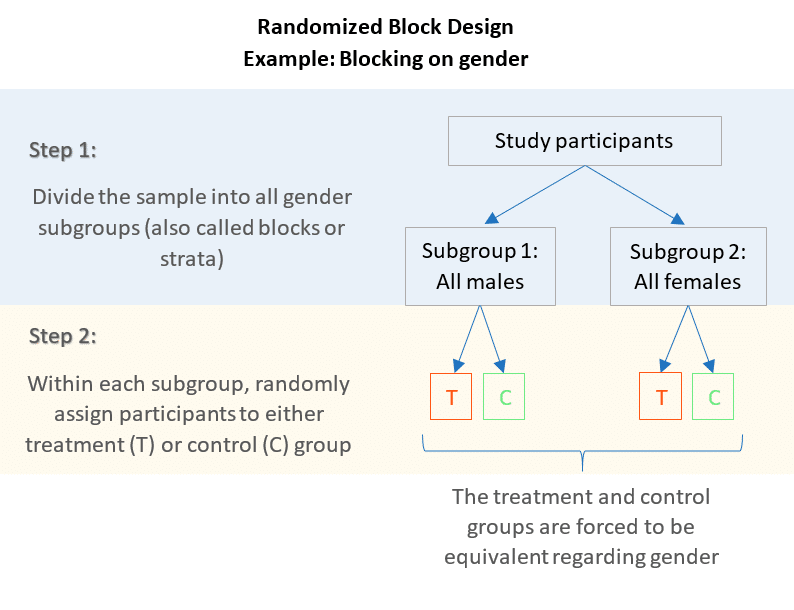
First the individual observational units are split into blocks of observational units that have similar values for the key variables that you want to balance over. After that, the observational units from each block are evenly allocated into treatment groups in a way such that each treatment group is allocated similar numbers of observational units from each block. Blocking is one of those concepts that can be difficult to grasp even if you have already been exposed to it once or twice. Because the specific details of how blocking is implemented can vary a lot from one experiment to another. For that reason, we will start off our discussion of blocking by focusing on the main goal of blocking and leave the specific implementation details for later.
Gutenberg 15.6 Introduces Experimental Details Block and Command Center for Site Editor - WP Tavern
Gutenberg 15.6 Introduces Experimental Details Block and Command Center for Site Editor.
Posted: Thu, 20 Apr 2023 07:00:00 GMT [source]
Complete Block Designs
One member of each matched pair must be randomly assigned to the experimental group and the other to the control group. This is a paired design, which is the most simple form of randomized complete block design. The ideal experimental design is the randomized controlled double-blind experiment. We use the usual aov function with a model including the two main effectsblock and variety.
What is a Randomized Complete Block Design (RCBD)?
In this design, you would have exactly two of each type of dough in each of the oven runs. You are studying how bread dough and baking temperature affect the tastiness of bread. And let's say you're purchasing packaged bread dough from some food company rather than mixing it yourself. Here is a concise answer.A lot of details and examples might be found in most documents treating the design of experiments; especially in agronomy.
Randomized Block Designs
We cannot fit a more complex model, includinginteraction effects, here because we do not have the corresponding replicates. Hence, a block is given by a locationand an experimental unit by a plot of land. In the introductory example, a blockwas given by an individual subject. Why is it important to make sure that the number of soccer players running on turf fields and grass fields is similar across different treatment groups? In this article we tell you everything you need to know about blocking in experimental design. First we discuss what blocking is and what its main benefits are.
Want to Pass Your Six Sigma Exam the First Time through?
Design, construction of breeze blocks focus of architecture student open house University of Hawaiʻi System News - University of Hawaii System
Design, construction of breeze blocks focus of architecture student open house University of Hawaiʻi System News.
Posted: Wed, 06 Apr 2022 07:00:00 GMT [source]
The current research proposes to investigate the effects of blocks in various shapes and positions on the net power output by changing the shape of the channels in the flow field (FF). For this reason, semicircular and triangular blocks were machined on the serpentine channels and their short-term performances were compared with the conventional serpentine pattern. In addition to the related new FF designs, performance evaluation was made by using nickel foam placed to fill the inner part of the serpentine FF. First, ultimate operating conditions were optimized with the traditional serpentine FF.
More specifically, blocking is used when you have one or more key variables that you need to ensure are similarly distributed within your different treatment groups. A matched pairs design is an experimental design where pairs of participants are matched in terms of key variables, such as age or socioeconomic status. One member of each pair is then placed into the experimental group and the other member into the control group. Independent measures design, also known as between-groups, is an experimental design where different participants are used in each condition of the independent variable. This means that each condition of the experiment includes a different group of participants.

This subset of columns from the whole Latin Square creates a BIBD. The principle of random allocation is to avoid bias in how the experiment is carried out and limit the effects of participant variables. Note, that the analysis where we ignore that we have multiple technical repeats for each bio-repeat returns results that are much more significant because we act as if we have much more independent observations. Note, that the power is slightly different because for the power.t.test function we conditioned on the mice from our study. While in the simulation study we generated data for new mice by simulating the mouse effect from a normal distribution. \(\rightarrow\) This reduces the variance of the residuals and leads to a power gain if the variability between mice/blocks is large.
Extraneous variables (EV)
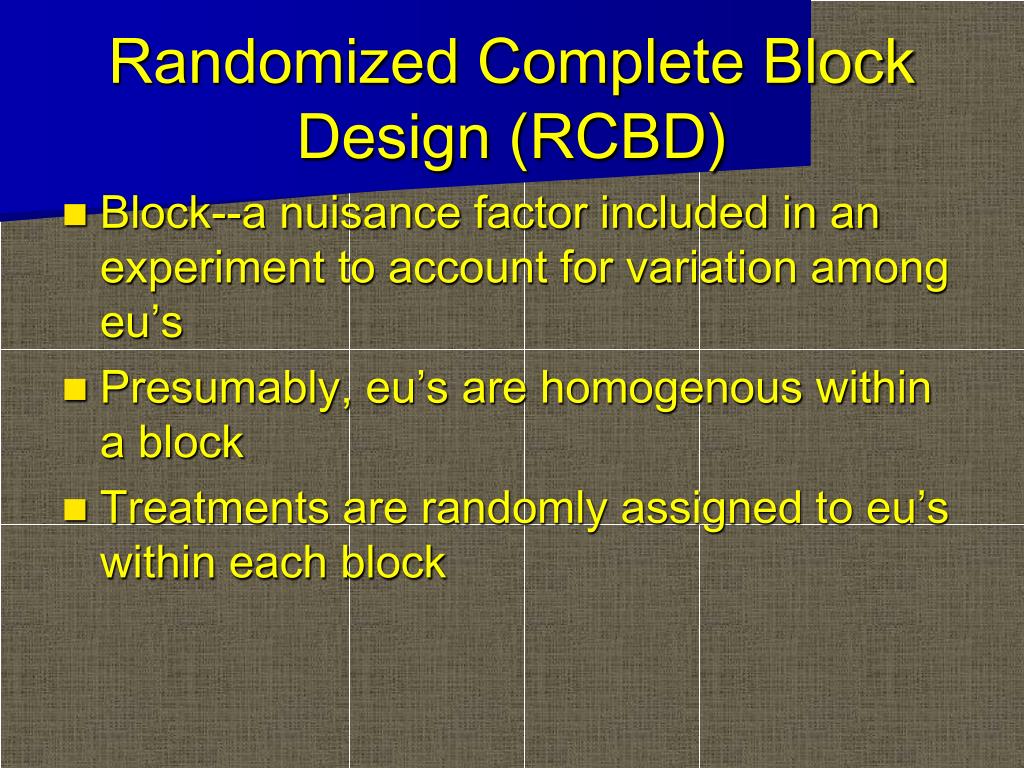
A Randomized Complete Block Design (RCBD) is defined by an experiment whose treatment combinations are assigned randomly to the experimental units within a block. Generally, blocks cannot be randomized as the blocks represent factors with restrictions in randomizations such as location, place, time, gender, ethnicity, breeds, etc. It is not simply possible to randomly assign a particular gender to a person. However, the presence of these factors (also known as nuisance factors) will introduce systematic variation in the study.
Difficulty in detecting/measuring the blocking variable
Blocking involves grouping experimental units based on levels of the nuisance variable to control for its influence. Randomization helps distribute the effects of nuisance variables evenly across treatment groups. The flow field pattern is crucial in many aspects such as cost-efficiency (in terms of excessive fuel consumption), water management on the cathode side, and achieving a high cell performance. The studies on the reconnaissance of much more effective flow field design have been continuing for years. As a matter of fact, it may be succeeded with some manipulations on the flow area.
Repeated Measures design is also known as within-groups or within-subjects design. This should be done by random allocation, ensuring that each participant has an equal chance of being assigned to one group. The primary interest is the treatment effect in any RCBD, therefore the hypothesis for the design is statistically written as.
For example, the crops produced in the northern vs the southern part will get exposed to different climate conditions. Controlling these nuisance factors by blocking will reduce the experimental error, thereby increasing the precision of the experiment and many other benefits. In the completely randomized design (CRD), the experiments can only control the random unknown and uncontrolled factors (also known as lucking nuisance factors). However, the RCBD is used to control/handle some systematic and known sources (nuisance factors) of variations if they exist. Note that blocking is a special way to design an experiment, or a special“flavor” of randomization.
The contrasts looking at recipe and recipe by dough non-additivity (interaction) do not have run-to-run variability in them. Technically, this is called variously a split-plot design structure or a repeated-measures design structure. Since \(\lambda\) is not an integer there does not exist a balanced incomplete block design for this experiment. Seeing as how the block size in this case is fixed, we can achieve a balanced complete block design by adding more replicates so that \(\lambda\) equals at least 1. It needs to be a whole number in order for the design to be balanced. Here we have treatments 1, 2, up to t and the blocks 1, 2, up to b.
The variable the experimenter manipulates (i.e., changes) is assumed to have a direct effect on the dependent variable. We expect the participants to learn better in “no noise” because of order effects, such as practice. However, a researcher can control for order effects using counterbalancing. In that sense, Latin Square designs are useful building blocksof more complex designs, see for example Kuehl (2000). When I have time to think it through, I'll update this further with the appropriate fancy names for those experiment designs.
A Latin Square design blocks on both rows and columnssimultaneously. If we ignore the columns of a Latin Square designs, the rows form anRCBD; if we ignore the rows, the columns form an RCBD. Here we have two pairs occurring together 2 times and the other four pairs occurring together 0 times. Therefore, this is not a balanced incomplete block design (BIBD). Randomized Complete Block Design (RCBD) is arguably the most common design of experiments in many disciplines, including agriculture, engineering, medical, etc. In addition to the experimental error reducing ability, the design widens the generalization of the study findings.
We consider an example which is adapted from Venables and Ripley (2002), the original source isYates (1935) (we will see the full data set in Section 7.3). Atsix different locations (factor block), three plots of land were available.Three varieties of oat (factor variety with levels Golden.rain, Marvellousand Victory) were randomized to them, individually per location. Typical block factors are location (see example above), day (if an experiment isrun on multiple days), machine operator (if different operators are needed forthe experiment), subjects, etc. Often, the researcher is not interested in the block effect per se, but he only wants to account for the variability in response between blocks. Of note, the block effect is typically considered as a random effect. Finally, if you expect the 'treatment effect' to differ from block to block, then interactions should be considered.
NF-serpentine FF contact highly decreased the ohmic resistance level of the cell when compared to the other designs according to the impedance (EIS) measurements. In addition, a correlation was observed between the performance and pressure drop test results. The highest-pressure drop was recorded with NF-serpentine FF (4.225 kPa) whereas the lowest is conventional serpentine FF (0.55 kPa). Traditional serpentine pattern is famous for with high-pressure drop structure. Consecutively, the pressure drop tests proved that the manipulations increased the pressure level of the system directly. If the number of times treatments occur together within a block is equal across the design for all pairs of treatments then we call this a balanced incomplete block design (BIBD).


No comments:
Post a Comment